
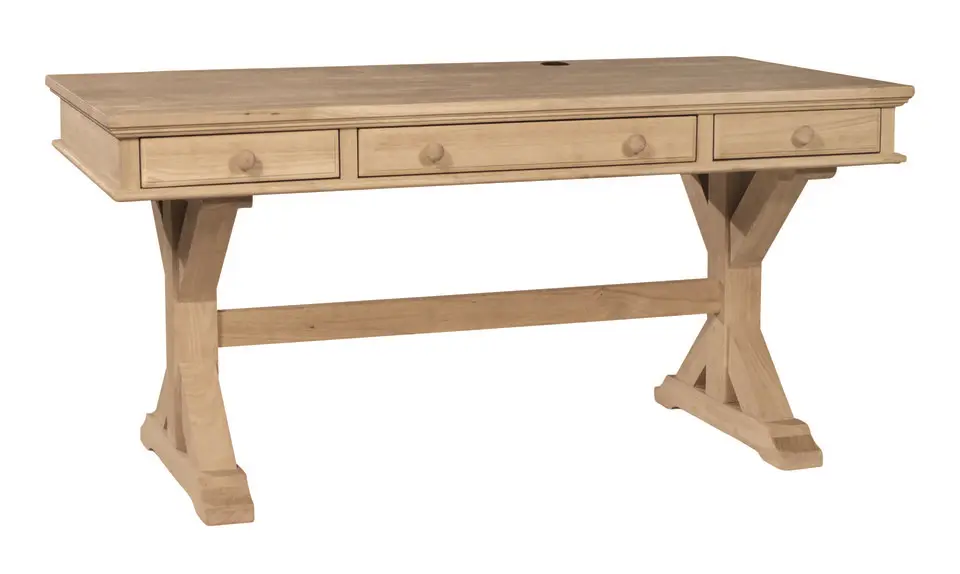
Building your own desk is one of the most satisfying and approachable woodworking projects you can take on. Unlike a flat-pack desk that arrives in a box and starts wobbling within a year, a desk you build yourself can be sized to your exact space, set to the perfect height for your body, made from wood you actually love, and built to last for decades. And you do not need a workshop full of expensive machinery to pull it off.
We at CO Lumber & Real Wood Furniture work with first-time builders and seasoned woodworkers every day here in Colorado Springs, and a desk is one of the projects we recommend most often to people who want to get started. It uses straightforward joinery, it does not require a huge amount of material, and you end up with something you will use every single day.
Whether you want a simple writing desk, a roomy work surface for two monitors, or something with a little more character, this guide will walk you through the whole process, from planning to the final coat of finish. Let us break it all down.
Why Build Your Own Desk?
Before we get into the how, it is worth a moment on the why, because the reasons people build their own desks are exactly the reasons it is worth doing well.
- You control the dimensions. Store desks come in a few standard sizes that may not fit your room or your body. When you build, the height, depth, and width are whatever you decide.
- You choose the material. You are not stuck with printed particleboard. You can build with real hardwood, cabinet-grade plywood, or a mix, and pick a species and grain that suits your style.
- It lasts. Real wood furniture built with sound joinery holds up for generations and can be repaired or refinished down the road, which you simply cannot do with a laminate desk.
- It is rewarding. There is a particular satisfaction in sitting down to work at something you made with your own hands.
Decide on Your Desk Design First
The biggest mistake new builders make is buying material before they have a plan. A little time with a pencil and tape measure up front saves money and frustration later.
Start by deciding what kind of desk you want. A simple writing desk is essentially a top sitting on four legs joined by an apron, and it is the best place to start if you are new. From there you can add drawers, a second tier, an L-shape, or a standing-height base, but the basic structure stays the same.
Next, settle on your dimensions. A few helpful starting points:
- Height: A standard desk surface sits around 29 to 30 inches off the floor, but the right height depends on you. For comfortable typing, your elbows should rest at roughly a 90 degree angle with your forearms parallel to the floor.
- Depth: Most desks run 24 to 30 inches deep. Go deeper if you use multiple monitors so the screens can sit at a comfortable viewing distance.
- Width: A writing desk is commonly 40 to 60 inches wide. Measure your space and your needs before committing.
Once you know your design and dimensions, sketch it out and write a cut list, which is simply a list of every piece you need with its final size. That cut list becomes your shopping list when you come to see us.
Choosing the Right Materials
This is the step where talking to a real lumber yard pays off, because the material you choose shapes everything about the finished desk. Here are your main options.
Solid Hardwood
For a desk that becomes a lasting piece of furniture, solid hardwood is hard to beat. It is strong, beautiful, and can be sanded and refinished for life. We stock more than 35 species of domestic and exotic hardwoods, from familiar favorites to striking woods like Padauk, Purpleheart, Zebrawood, and Brazilian Cherry.
One important thing to understand when buying solid lumber is how it is surfaced. We carry hardwood in two forms:
- S4S lumber, which is surfaced on all four sides. This material has straight edges, is sanded on the face and back, and is ready to work with right away. We carry it in “one by” sizes from one by two up through one by twelve. For a beginner without a jointer or planer, S4S is the easy path, because it is ready for finishing out of the rack.
- S2S lumber, which is surfaced on the two faces but has rough edges. This is meant for woodworkers and cabinet makers who have the tools to take it from a slightly rough state to a finished one.
If you want a solid wood top, you will typically edge-glue several boards together to reach your desired width. You can explore the full range on our lumber page, and if you do not have the tools to dimension your own boards, we can help.
Plywood
Plywood is an excellent, cost-effective choice for a desk top, and a quality sheet can look fantastic with the right edge treatment. We stock over 25 species of graded plywood, mostly in quarter-inch and three-quarter-inch thickness, in full four-by-eight sheets as well as half and quarter sheets so you are not paying for more than you need.
A few plywood notes for a desk build:
- Three-quarter-inch cabinet-grade plywood makes a stable, flat desk top that will not move with the seasons the way solid wood can.
- Baltic Birch is our recommendation when you want something stronger and flatter. It has more plies, is nearly void-free, and stays exceptionally flat, which is ideal for a large work surface.
- Edge treatment matters. Raw plywood edges are not attractive, so plan to cover them with iron-on veneer edge banding or a thin strip of solid wood for a finished look.
See our plywood page for the full selection and core options, including veneer core, combination core, and MDF core.
Softwood
If you are after a budget-friendly or rustic look, softwood like pine is an option. It is affordable and easy to work, though it dents more easily than hardwood and is less commonly used for furniture. It can be a fine choice for a first practice build or a casual desk.
Tools You Will Need
You can build a simple desk with a modest tool kit. At minimum, plan to have:
- A tape measure and a square for accurate layout
- A saw, whether a circular saw, miter saw, or even a handsaw for cutting to length
- A drill and driver for assembly
- A sander, or sandpaper and a sanding block
- Clamps, wood glue, and screws
- Finishing supplies such as a brush or rag and your chosen finish
A pocket-hole jig is an inexpensive, beginner-friendly addition that makes joining the apron to the legs simple and strong. And if you do not own a saw that can break down a full sheet of plywood or cut your boards to final size, that is not a dealbreaker, as we will cover next.
Step by Step: Building a Simple Desk
Here is the general process for a basic four-leg writing desk. Adjust as needed for your specific design.
- Acclimate your wood first. Bring your lumber home and let it sit in the room where the desk will live for several days before building. This matters especially here in Colorado, where our dry air pulls moisture out of wood.
- Cut your pieces to size. Following your cut list, cut the top boards, the four legs, and the apron pieces. Accuracy here makes assembly much easier.
- Build the top. For a solid wood top, lay out your boards for the best grain match, apply glue along the edges, and clamp them together until cured. For a plywood top, cut the panel to size and apply your edge banding or solid wood edging.
- Assemble the base. Join the apron pieces to the four legs to form a sturdy frame, using pocket-hole screws and glue or your preferred joinery. Check that the frame is square as you go.
- Attach the top to the base. This is the step most beginners get wrong. A solid wood top expands and contracts across its width with the seasons, so it must be fastened in a way that lets it move. Use tabletop fasteners, figure-eight clips, or elongated screw holes rather than gluing it down solid. A plywood top is stable and does not need this allowance.
- Sand everything smooth. Work up through the grits, typically 120, then 150, then 180, removing dust between passes. Smooth, even sanding is what makes a finish look professional.
- Finish the desk. Apply your chosen finish, following the product directions, and let each coat cure fully before use.
Finishing Your Desk
A desk is a work surface, so the finish needs to stand up to daily use, the occasional coffee cup, and a forearm resting on it for hours. You have a few good options:
- Polyurethane, brushed or wiped on, gives a durable, protective film and is forgiving for beginners. Water-based versions dry clear and fast.
- Hardwax oil offers a more natural look and feel and is easy to spot-repair, though it offers less of a hard protective shell than poly.
- Paste wax can be used over other finishes for a soft sheen, but on its own it does not protect a heavy-use surface well.
Whatever you choose, test it on a scrap piece of the same wood first so there are no surprises on the finished top.
Prefer to Skip Part of the Build? We Can Help
Not everyone has a full shop, and that is completely fine. One of the advantages of starting your project with us is that you do not have to do every step yourself. We can cut wood to size, so you can have your boards and sheet goods dimensioned and ready to assemble at home with basic tools.
And if you decide a full build is not for you after all, our in-house custom woodworking shop can design and build a desk to your exact specifications, from the wood species to the dimensions to the details. If you would rather buy a finished piece, we also carry a wide range of real wood furniture, including desks, for every room of the home. There is no wrong way to end up with a great desk.
Why Start Your Desk Project at a Local Lumber Supplier
You can grab a few boards at a big-box store, but you will not get the selection or the guidance you need to build something you are proud of. That is where a local lumber supplier makes the difference.
As a locally owned, owner-operated company, we take the time to understand your project and point you toward the right material for it. We can tell you which species suits a desk top, whether S4S or S2S makes sense for your tools, and which plywood will stay flattest for a wide work surface. We are trusted by builders, remodelers, and woodworkers across the region precisely because we treat every project, large or small, with that kind of attention.
We also stock the breadth that a hardware store simply cannot, with over 35 hardwood species, more than 25 plywood options, softwoods, and the relationships to special-order what we do not have on hand. When you are building something meant to last, starting with the right wood and the right advice is half the battle.
Visit Us in Colorado Springs
We invite you to stop by our showroom and lumber yard at 3636 N. Stone Ave, Colorado Springs, CO 80907. Our team is available Monday through Friday from 8:00 AM to 5:30 PM and Saturday from 9:00 AM to 5:00 PM. We are closed on Sundays.
If you would like to talk through your project before you come in, give us a call at (719) 389-0100, email us at inquiries@columber.net, or reach out through our contact page. Bring your cut list and we will help you choose the wood, get it cut to size, and set you up for a successful build.
Come see us, and let us help you make a desk you will be proud to sit down at every day.