
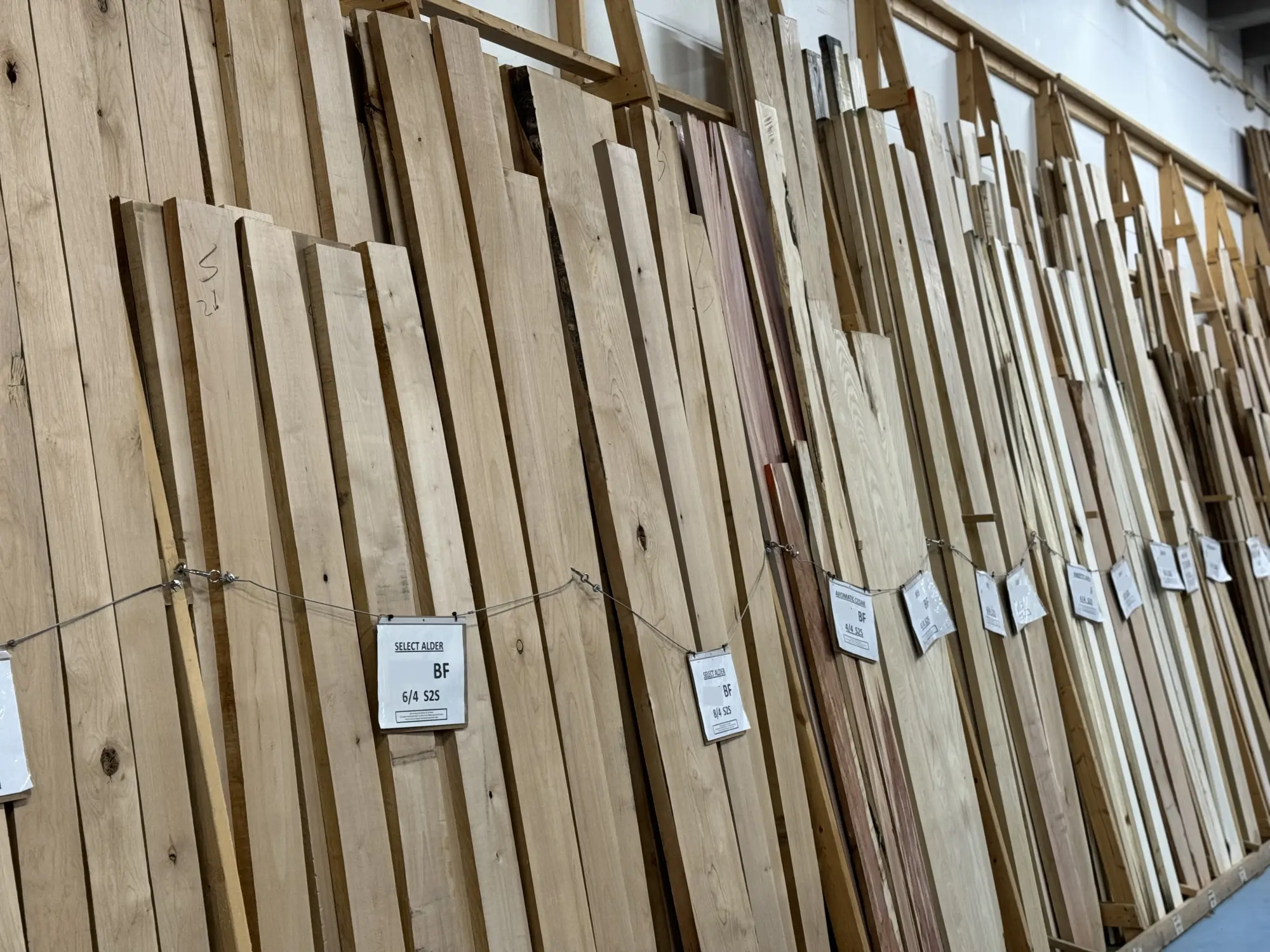
If you have ever walked into a lumber store and stared at a stack of boards marked with letters and numbers that meant nothing to you, you are not alone. Lumber grades can feel like a secret language, and without someone to translate, it is easy to overspend on material you do not need or, worse, buy the wrong grade for a project and run into problems down the road.
At CO Lumber & Real Wood Furniture, we work with homeowners, DIY enthusiasts, and professional woodworkers every day here in Colorado Springs, and lumber grades come up in almost every conversation. We want to make this topic easy to understand so you can walk in knowing exactly what you are looking for. Whether you are building a deck, crafting a dining table, or tackling a cabinet project, understanding lumber grades will save you time, money, and frustration.
Let us break it all down.
What Are Lumber Grades, and Why Do They Matter?
Lumber grading is a standardized system used to classify wood based on its appearance, strength, and the number of defects present in a given board. Defects include knots, checks (small cracks along the grain), splits, warp, stain, and other natural characteristics that can affect how a board looks or performs.
Grading standards exist so that buyers and sellers have a shared, consistent language. When you order a specific grade, you know roughly what to expect before the wood ever arrives. That consistency is valuable whether you are sourcing a few boards for a weekend project or ordering in bulk for a professional build.
Two separate grading systems apply depending on the type of wood you are working with: one for hardwoods and one for softwoods. We carry both at our Colorado Springs location, so understanding both systems will serve you well.
Hardwood Lumber Grades: The NHLA System
Hardwood grading in the United States is governed by the National Hardwood Lumber Association (NHLA). The NHLA has published grading rules since 1898, and their system is used by lumber yards and woodworkers across the country. The grades are based on the percentage of clear, usable wood you can cut from a given board. A higher grade means a higher percentage of clear material and fewer defects.
Here is a breakdown of the main NHLA hardwood grades:
FAS (Firsts and Seconds)
FAS is the highest grade available for hardwood lumber. Boards graded FAS are at least 6 inches wide and 8 feet long, and they must yield at least 83.3 percent clear cuttings. This means the vast majority of the board is free of knots, checks, and other visual imperfections.
FAS lumber is ideal for furniture, cabinetry, and fine woodworking where you need large, uninterrupted surfaces. It is the most expensive grade, but for projects where appearance is a priority, it is worth it.
FAS One Face (F1F)
F1F is a combination grade. One face of the board meets FAS standards, while the other face meets the requirements for a lower grade called Select. This grade works well when only one side of the board will be visible, such as in cabinet doors or the top surface of a table.
Select
Select grade boards are similar to FAS but are slightly smaller, with a minimum width of 4 inches. They must yield at least 83.3 percent clear cuttings, just like FAS. For most furniture and cabinet projects, Select grade offers excellent value because you get near-FAS quality at a lower price point.
No. 1 Common
No. 1 Common (often called #1 Com) is one of the most popular grades for practical woodworking. Boards must yield at least 66.7 percent clear cuttings. This means you will have more knots and character marks, but there is still plenty of usable clear wood in each board.
1 Common is a strong choice for projects where some natural character is acceptable or even desirable, such as rustic furniture, flooring, and paneling. It tends to offer a great balance between quality and cost.
No. 2 Common
No. 2 Common boards yield at least 50 percent clear cuttings. You will see more knots and irregularities, which makes this grade better suited for painted projects, box construction, shelving in non-visible areas, and utility applications. It is an economical option when appearance is secondary to function.
No. 3 Common
No. 3 Common is the lowest standard grade for hardwoods and yields at least 33.3 percent clear material. This grade is typically used in applications where strength and appearance matter very little, such as pallets, crates, and temporary structures.
Softwood Lumber Grades: Structural vs. Appearance
Softwoods such as pine, cedar, and fir follow a different grading system, primarily because softwoods serve a wider range of purposes, from structural framing to fine finish work.
Softwood grades fall into two broad categories:
Structural Grades
Structural grades focus on strength rather than appearance. These are the grades you see stamped on dimensional lumber at big-box stores, the 2x4s and 2x6s used to frame walls, floors, and roofs. Common designations include:
- Select Structural: The highest strength rating, used where load-bearing capacity is critical.
- No. 1: Strong and suitable for most construction framing needs.
- No. 2: The most widely used structural grade; meets building code requirements for most applications.
- No. 3: Lower strength, suitable for non-critical structural uses or temporary work.
- Construction, Standard, and Utility: These grades are used for general framing where appearance is not a concern.
Appearance Grades
When softwoods are used in finish carpentry, trim, paneling, or furniture, appearance grades take over. These grades evaluate visual characteristics more closely. Common appearance categories include:
- Clear: Very few or no knots; used in high-end trim and finish work.
- Select: Minor defects allowed; a good choice for stained or natural finish applications.
- Common (No. 1 through No. 5): Increasing numbers indicate more knots and defects; lower numbers are used in knotty pine paneling and rustic applications.
As a leading lumber store in Colorado Springs,our team can help you identify the right appearance or structural grade based on your specific project.
What Does S2S and S4S Mean?
You will often see lumber described as S2S or S4S, and these designations refer to how the wood has been surfaced at the mill. Understanding this will help you know how much additional milling work your project will require.
S2S (Surfaced 2 Sides)
S2S lumber has been planed smooth on both faces, but the edges are left rough. Most of our domestic hardwood at CO Lumber is offered as S2S. This works well for woodworkers, cabinet makers, and anyone with the tools and skills to rip and joint the edges themselves. S2S lumber offers flexibility because you can cut it to the exact widths your project requires while removing the rough edges in the process.
S4S (Surfaced 4 Sides)
S4S lumber has been planed smooth on all four sides, meaning both faces and both edges are finished and square. This is the “ready to use” option. S4S boards are sanded on the face and back and feature straight edges, so they can go straight from the rack to your project with minimal prep work.
We carry many species in S4S at our Colorado Springs store, and this is a popular choice for customers who want to skip the milling step and get straight to building. If you want to see exactly what we have in stock, you can find our current S4S lumber list and S2S lumber list on our website.
How to Choose the Right Lumber Grade for Your Project
Choosing the right grade comes down to three questions: What will the wood be used for? Will the surface be visible? And what is your budget?
Here is a simple framework we share with customers:
For fine furniture, dining tables, and cabinetry:
Choose FAS, Select, or F1F hardwood grades. You want clean, consistent boards with minimal defects, especially on the surfaces that will be stained or left natural. We stock over 35 species of domestic and exotic hardwoods, including Padauk, Purpleheart, Zebrawood, and Brazilian Cherry, so you have plenty of beautiful options to choose from.
For rustic furniture, flooring, and paneling:
No. 1 Common hardwood is typically the sweet spot. You get real character from natural knots and grain variation while keeping costs down. Many customers actually prefer the look of #1 Common for farmhouse or cabin-style aesthetics.
For painted projects or utility shelving:
No. 2 Common or lower grades work well here. Since paint covers the wood’s natural appearance, spending extra for a clearer grade does not make sense.
For framing, decking, or structural work:
Structural softwood grades are your answer. Most residential framing uses No. 2 dimensional lumber, which meets building code requirements and offers reliable strength. If you are building an outdoor deck, ask us about the appropriate species and grade for Colorado’s climate and UV exposure.
For finish trim, moulding, and detailed millwork:
Clear or Select softwood grades deliver the cleanest look for painted or stained trim. We also carry a comprehensive selection of mouldings here in Colorado Springs, so if your project involves decorative trim, we have you covered.
A Note on Exotic and Specialty Hardwoods
Standard grading rules do not always apply uniformly to exotic or specialty hardwoods. Species imported from other countries may be graded according to the producing country’s standards rather than NHLA guidelines. This is important to keep in mind when you are comparing prices across species.
At CO Lumber & Real Wood Furniture, we work with the top lumber suppliers in the industry and maintain relationships that let us source specialty species not commonly found at big-box retailers. When you come in and ask about a species like Purpleheart or Zebrawood, our team can walk you through the specific quality characteristics of what we have on hand so you can make a confident decision. We believe in giving every customer the kind of personalized attention you simply cannot get at a chain store.
Why Buying from a Knowledgeable Local Source Makes a Difference
Grading rules tell part of the story, but they do not tell all of it. Two boards with the same grade can look and perform quite differently depending on species, how the wood was dried, and how it has been stored. That is why buying from a locally owned lumber store with experienced staff matters so much.
We have been serving Colorado Springs homeowners, woodworkers, and craftsmen for years, and we take real pride in knowing our inventory well. When you come in, you are not just buying boards off a shelf. You are talking to people who genuinely understand wood and want your project to succeed. Whether you need a single board for a small repair or a full supply of material for a large custom build, we treat every order with the same level of care.
We also offer custom woodworking services for customers who want help taking a project from raw material to finished product. If you have a design in mind but need professional hands to bring it to life, our shop is here for you.
Visit Us in Colorado Springs
We invite you to stop by our Colorado Springs store at 3636 N. Stone Ave, Colorado Springs, CO 80907. Our team is available Monday through Friday from 8:00 AM to 5:30 PM and Saturday from 9:00 AM to 5:00 PM. We are closed on Sundays.
If you would rather get in touch before your visit, give us a call at (719) 389-0100 or contact us online. We are happy to answer questions about grades, species, surface treatments, or anything else related to your project.
Understanding lumber grades is one of the most practical things a homeowner or woodworker can do to make better buying decisions. Now that you know the difference between FAS and #1 Common, between S2S and S4S, and between structural and appearance grades, you are ready to shop with confidence. And when you are ready to pick out your boards, we hope to see you here.